
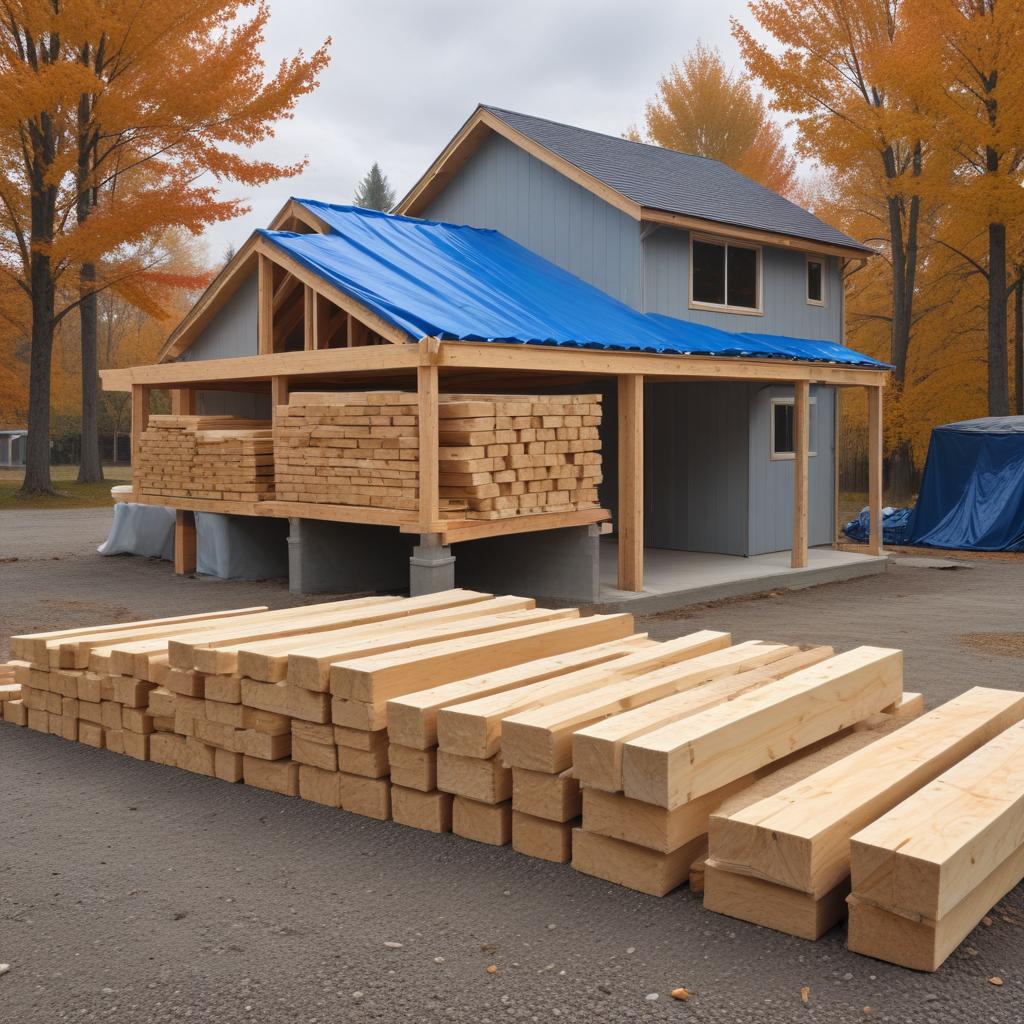
Protect Jobsite Materials Through Midstate Fall Rain and First Frost
October is one of the better months to build in Middle Tennessee. The heat has broken, crews are moving fast, and a lot of projects are trying to get framed, sheathed, and dried in before the holidays. It is also the stretch of the year when material sitting on a jobsite starts seeing more wet days, heavy dew, and the first nights near freezing.
That combination is where avoidable losses happen. A bundle of sheathing left flat on the dirt, a stack of drywall delivered a week early, or a pallet of bagged mix under a tarp that pools water can turn into warped panels, stained facers, and hard bags. None of that shows up on the delivery ticket, but it shows up in callbacks, rework, and replacement orders.
This guide pulls together what the manufacturers and trade associations actually say about storing the most common materials on site, and how that applies to fall conditions in the Midstate.
What fall weather looks like on a Nashville-area jobsite
The National Weather Service climate normals for Nashville give a useful picture of what the next three months bring:
- Rainfall stays steady. Normal precipitation is about 3.36 inches in October, 3.86 inches in November, and 4.43 inches in December.
- Wet days pick up. Nashville averages about 5 days with at least a tenth of an inch of rain in October, 6 in November, and 7 in December.
- Freezing nights arrive. On average there is about 1 night at or below 32°F in October, about 8 in November, and about 16 in December.
The takeaway for storage is simple. Material that arrives in October may sit through several soaking rains and, by late fall, a run of cold nights and wet mornings before it is installed. Storage that was "good enough" in a dry September may not hold up in November.
Start with the delivery schedule
The cheapest protection is not having material sit outside at all. The Gypsum Association's handling and storage guide (GA-801) says gypsum panel products should be delivered just prior to installation. The Southern Forest Products Association (SFPA) similarly recommends minimizing jobsite storage time and getting the structure enclosed as soon as possible.
In practice, that means:
- Stage deliveries by phase. Framing lumber and sheathing first, then roofing and wrap, then siding and trim, then drywall once the building is dried in.
- Ask for the first-used material to be loaded on top so it comes off the truck in the order you need it.
- Avoid accepting deliveries in the rain when you can shift the drop by a day.
- Decide where each delivery will go before the truck arrives, so nothing ends up dropped in a low spot or a muddy drive.
Framing lumber and treated lumber
SFPA's storage guidance for Southern Pine is direct:
- Unload lumber in a dry place, not in wet or muddy areas.
- Elevate it on stringers so it does not absorb ground moisture and air can circulate. SFPA calls for units to be supported at least four inches off the ground.
- Cover lumber stored in the open. Polyethylene and other non-porous covers act as a vapor barrier, so leave ventilation around the material to prevent condensation on the underside of the cover.
- Get framing lumber under a roof as soon as possible.
SFPA also notes that properly dried lumber, at 19% moisture content or less, does not contain enough water to support mold growth, but any wood product can become vulnerable if it is not protected from moisture during storage and construction. Scrap piles on the ground give mold something to feed on, so keep cutoffs separated from the storage area.
Pressure-treated lumber follows the same rules. SFPA states that the same storage guidelines used for untreated lumber apply to treated products: keep it elevated, ventilated, and shielded from excess moisture.
A common fall mistake is wrapping a lumber unit tightly in plastic all the way to the ground. On a cool night followed by a sunny morning, that wrap can trap moisture inside the stack. Cover the top, let the sides breathe, and keep the bottom open.
OSB and plywood sheathing
APA, The Engineered Wood Association, publishes specific outdoor storage guidance for wood structural panels:
- Store panels under a roof whenever possible.
- If they must be stored outside, stack them on a level platform supported by at least three 4x4s. Put one in the center and the other two 12 to 16 inches from the ends.
- Never leave panels or the platform in direct contact with the ground.
- Cover the stack loosely with plastic sheets or tarps. Anchor the cover at the top, but keep it open and away from the sides and bottom for ventilation. APA warns that tight coverings prevent air circulation and, in sunlight, may promote mold or mildew.
- If moisture absorption is expected, cut the steel bands on bundles to prevent edge damage.
- Lay a few pieces of lumber on the top panel to reduce warping from humidity.
APA also notes that panels expand as they reach equilibrium moisture content, which is why it recommends leaving a 1/8-inch gap at panel ends and edges during installation. Sheathing that has been sitting wet on site will have taken on extra moisture before it ever goes on the wall, so dry storage and proper spacing work together.
Drywall and other gypsum panels
Gypsum board is the least forgiving material on this list. GA-801 states that gypsum panels must be stored in dry conditions and should not be stored outdoors, because exposure to rain and high moisture can cause water stains, discoloration, mold, facer delamination, and sag.
Key points from the Gypsum Association:
- Keep panels in an enclosed, covered, dry area. GA-801 gives a garage as an example on a jobsite.
- Store panels flat and evenly supported on a firm, dry, level surface. Do not stack them on edge.
- Remove plastic shipping covers on arrival. That wrap is meant for transport, not storage, and leaving it on can lead to moisture, condensation, or mold damage.
- Keep stacks out of heavy traffic areas where they can be hit by equipment.
The practical rule for fall work is not to bring drywall onto a site until there is a dried-in space to put it in. If the roof, windows, and doors are not closed up, the drywall delivery should wait.
Fiber cement siding and trim
James Hardie's installation and storage instructions are clear that its siding and trim products must be kept dry at all times before installation. The company specifies:
- Store products flat in their original packaging.
- Keep them off the ground on a pallet, never in direct contact with the ground.
- Store in a garage, shed, or other covered area when possible. If stored outside, add a waterproof covering.
- Cover scrap pieces, cutoffs, and material left on scaffolding as well.
- If product becomes saturated, lay it on a flat surface and let it dry completely before installing.
The reason matters for scheduling. James Hardie warns that installing wet or saturated siding may result in shrinkage at butt joints. On a fall job where the siding crew is chasing a weather window, a wet pallet can cost more time than waiting a day for the right conditions.
Handling counts too. Lap siding, trim, and soffit should be carried on edge, not flat, to avoid breakage, and panels should be carried by two people.
Bagged cement, mortar, and concrete mix
Portland cement readily absorbs moisture, even from humid air. Concrete construction training references note that cement that absorbs appreciable moisture in storage sets more slowly and loses strength, and that bags should not be used if they contain lumps or are not free-flowing.
For bagged products on a fall jobsite:
- Keep bags off the ground on a pallet or raised platform.
- Store them in a shed, trailer, or garage when possible.
- If they must stay outside, cover them with a waterproof tarp that extends past the edges of the platform so water runs away from the bags rather than pooling on top.
- Keep stacks away from exterior walls where moisture can wick in.
- Use older bags first.
Bags stacked a long time can develop "warehouse pack," a firmness that usually loosens when the bag is rolled. That is different from bags that have taken on water and set into hard lumps, which should be discarded.
A quick fall storage checklist
Before the next rain moves through, walk the site and check:
- Is every unit of lumber, sheathing, and siding off the ground on stringers or pallets?
- Are covers anchored at the top and open at the bottom, not wrapped tight to the ground?
- Is drywall indoors, flat, and out of its shipping plastic?
- Is fiber cement covered with a waterproof layer and stored flat?
- Are bagged products on a pallet, under a cover that sheds water away from the stack?
- Are scraps and cutoffs separated from stored material?
- Is the next delivery timed to the phase of work, not just the earliest available truck?
Planning your fall material orders
Good storage starts with ordering the right quantities at the right time. Music City Building Supply works with builders, remodelers, and contractors across Middle Tennessee from our yard in Columbia, and we can help you think through what to bring in now and what can wait until the house is dried in.
Availability changes as surplus and wholesale lots move, so call us at 615-385-7777 or stop by 1230 Industrial Park Road in Columbia to check what is on hand for your next phase.
Sources
- National Weather Service Nashville, Nashville climate normals and records (weather.gov/ohx/bnaclimate)
- Gypsum Association, GA-801-2023 Handling and Storage of Gypsum Panel Products
- APA, The Engineered Wood Association, Builder Tips and Storage and Handling of APA Trademarked Panels (Form U450)
- Southern Forest Products Association, Southern Pine Lumber Storage and Mold and Moisture guidance
- James Hardie, Best Practices installation guide and HardiePlank storage and handling instructions
- Concrete construction training reference on cement storage (mypdh.engineer)
Need materials for your next project?
We'll source it and get you a fast, no-obligation quote.