
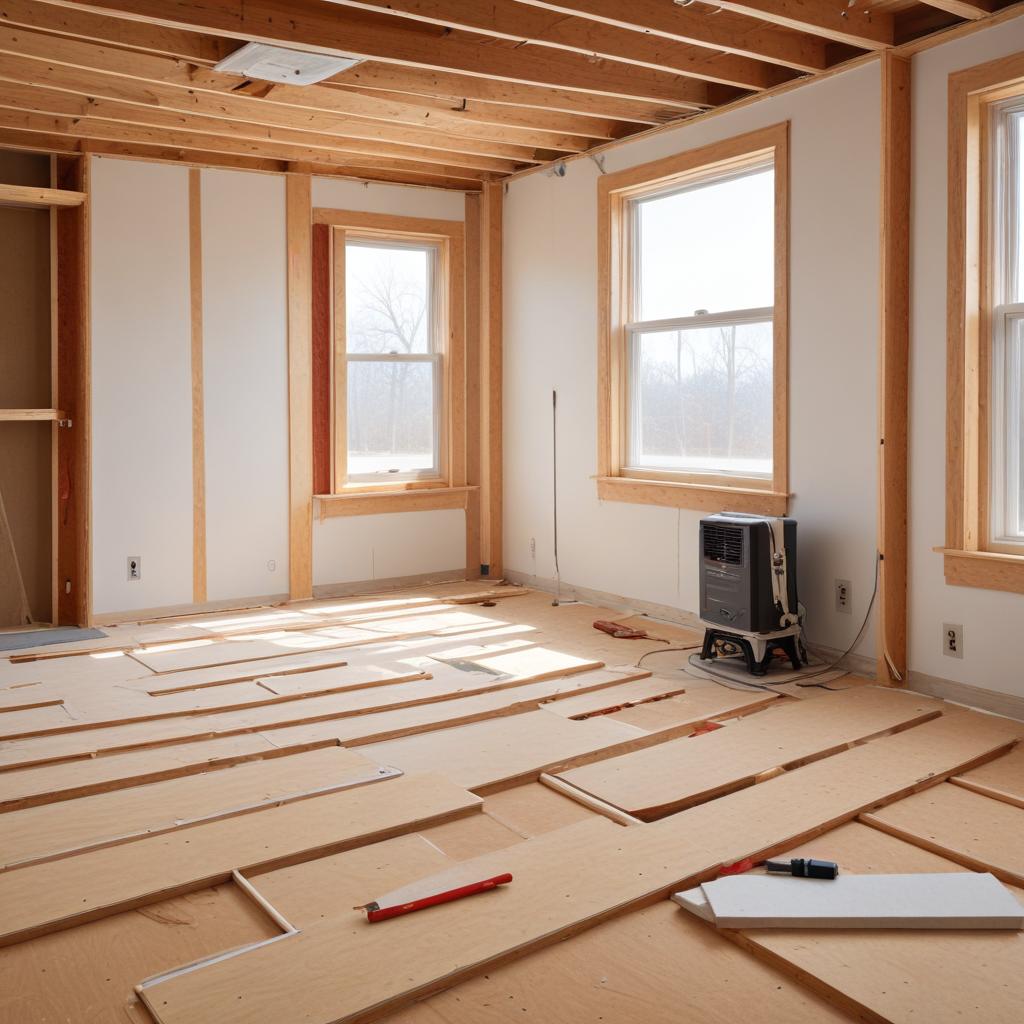
Heating-Season Drywall, Trim, and Wood Floors for Midstate Builds
Late October is when a lot of Middle Tennessee projects move indoors. Framing is up, the roof is on, windows are going in, and crews start thinking about hanging board, running trim, and getting floors down before the holidays. It is also when the weather starts working against interior finishes. National Weather Service Nashville climate normals show about eight nights at or below freezing in a typical November, and the mean date of the first 32°F night is November 11. Daylight saving time ends November 1, so evenings get colder and darker at the same time.
Drywall mud, paint, trim, and wood flooring all have temperature and humidity limits written into their industry standards. Most of those limits are much warmer than "above freezing." This guide pulls together what the Gypsum Association, the National Wood Flooring Association (NWFA), the USDA Forest Products Laboratory, and OSHA say, and how that applies to a Midstate house going through its first cold weeks. It does not replace the project specs or the data sheets for the products on your order. When a manufacturer's numbers differ from the general guidance below, follow the manufacturer.
Why "the house is dried in" is not the same as "the house is ready"
A dried-in shell keeps rain off the framing, but an unheated shell in November still swings with the outdoor air. Cold nights pull interior surfaces down. Damp mornings push humidity up. Materials brought in during that swing pick up moisture or chill, then move once the heat comes on.
The standards draw a clear line here. The Gypsum Association's GA-216, Application and Finishing of Gypsum Panel Products, and its winter bulletin GA-220 tie drywall work to controlled room temperatures. The NWFA's installation guidelines say wood flooring should not even be delivered until the building's mechanical systems have been running and holding the right conditions. The USDA Wood Handbook says to install interior wood at the moisture content it will see in service. All three point the same way: get the building into its heated, everyday condition first, and then bring in the finish materials.
If you closed up the envelope earlier this fall, this is the next step. Insulation and air sealing make it far easier and cheaper to hold steady heat for finish work.
Drywall: the 40°F and 50°F rules
The Gypsum Association sets two numbers that matter this time of year.
- 40°F for hanging board. GA-216 calls for a room temperature of at least 40°F (4°C) for mechanical attachment of gypsum panels, meaning screws or nails.
- 50°F for everything wet. For adhesive attachment, joint treatment, texturing, and decoration, the room should stay at 50°F (10°C) or warmer. For joint treatment, that 50°F starts at least 48 hours before mixing or application and continues until the compound is thoroughly dry.
GA-220 adds a few winter specifics that are worth posting on the jobsite:
- Don't apply panels or joint treatment to cold or damp surfaces.
- After the board is hung, hold the interior at 50°F or above for at least 48 hours before priming and decorating begins.
- Protect ready-mixed joint compound and texture from freezing. A pallet of buckets left in an unheated garage overnight is a real risk in November.
- With temporary heat, keep any room at or below 95°F (35°C). GA-236 also warns against pointing heaters directly at wall surfaces, because local overheating can make compound dry too fast, crack, and delaminate.
- Provide steady ventilation during installation and while materials dry or set.
According to GA-220, cold and damp conditions can lead to joint compound bond failure, delayed shrinkage, ridging, fastener pops, joint shadowing, and ceiling sag. Most of those problems show up weeks later, after paint, when they are much harder to fix.
GA-236, Joint Treatment Under Extreme Weather Conditions, recommends setting-type joint compounds when conditions are cold and wet. It also says to let each coat dry fully before the next one, and to store tape and powder compounds off the ground in a dry area.
The problem with propane and kerosene heat
Portable gas and kerosene heaters are the usual answer to a cold house. They also add a lot of water vapor to the air.
GA-216 says that when portable gas or kerosene heaters are used, the extra humidity they produce has to be removed. GA-220 says to remove it with ventilation or mechanical dehumidification. The NWFA's guidelines go further for wood floors. They note that propane combustion produces large amounts of water and that propane systems should be avoided before, during, and after wood flooring installation.
In practice, that leaves a few options:
- Run the permanent HVAC system as early as it can safely be started, if the builder and mechanical contractor agree it is ready for construction use.
- Use electric or indirect-fired temporary heat that vents combustion gases outside the work area.
- If direct-fired heaters are the only choice, pair them with real ventilation and dehumidification, and measure humidity instead of guessing.
Carbon monoxide is a safety issue, not just a finish issue
Fuel-burning heaters in a closed-up house also create a carbon monoxide hazard. OSHA's construction standard for temporary heating devices, 29 CFR 1926.154, requires enough fresh air for workers' health and safety, and mechanical ventilation where natural air supply is not enough. The same standard sets clearance distances from combustibles and requires heaters near tarps or canvas to sit at least 10 feet away from the coverings.
OSHA's carbon monoxide fact sheet lists space heaters among common sources of CO exposure and recommends personal CO monitors with audible alarms where exposure is possible. In a 1988 interpretation, OSHA pointed to the ANSI A10.10 practice of testing for CO within an hour after each shift starts and at least four hours later when heaters run in enclosed or partly enclosed structures. Under that practice, a heater is shut off if CO at breathing level goes above 50 ppm, unless added mechanical ventilation brings it back down.
A low-cost CO monitor and a written heater checklist do more to protect a crew than any finish schedule.
Trim and millwork: match the wood to the house it is going into
Interior trim, doors, stair parts, and cabinetry move with moisture, and heating season is when that movement shows up. The USDA Forest Products Laboratory's Wood Handbook recommends an average moisture content of about 8% for interior woodwork in heated buildings in most of the United States, with individual pieces between 6% and 10%. The Handbook's guidance is simple: install wood at the moisture content it will experience in service.
That is why trim brought straight from a damp, unheated space and nailed up on a 45°F morning often opens at the miters and shows gaps by January. A few habits help:
- Get the house heated and holding steady before trim arrives, not on the same day.
- Store millwork inside the conditioned space, off the slab or subfloor, with air around the bundles.
- Use a moisture meter on a sample of the stock and compare it with the 6% to 10% range, or with the manufacturer's number if one is given.
- Keep in mind that framing lumber is a different product. Under the American Softwood Lumber Standard, "dry" softwood lumber can be up to 19% moisture content, so framing will keep drying and shrinking for a while after the heat comes on.
Wood flooring: conditions first, then delivery
The NWFA's installation guidelines are strict about timing. Wood flooring should be one of the last jobs in a remodel or new build. It should not be delivered or installed until:
- The envelope is fully enclosed, with windows, doors, siding, soffits, roofing, insulation, and ventilation in place.
- Wet trades inside the thermal envelope are finished. That includes concrete, masonry, plaster, drywall, texturing, and painting.
- Permanent or temporary HVAC capable of holding the required conditions has been running for at least five days before delivery. The guidelines note that tighter houses and wet conditions may need longer.
For solid wood flooring, the NWFA's general rule is an interior temperature of 60°F to 80°F and relative humidity of 30% to 50%. There are regional exceptions, and factory-finished and engineered products should follow their manufacturer's requirements. The guidelines also call for testing and documenting temperature and humidity in each room where flooring goes in. That record protects the installer, the builder, and the homeowner if a question comes up later.
For a Midstate builder in late October, the order of work is the takeaway: finish drywall and paint, get the heat stable and the humidity in range, document it, and only then bring in the flooring.
A quick heating-season checklist
- Confirm the heat source and how it will be vented before drywall finishing starts.
- Keep rooms at 50°F or warmer from 48 hours before mud work until it is fully dry, and for 48 hours before priming.
- Keep temporary heat under 95°F and never pointed at fresh joints.
- Move buckets of ready-mixed compound and texture somewhere they cannot freeze.
- Remove extra moisture from fuel-burning heaters with ventilation or dehumidifiers.
- Put CO monitors on the crew and test the air on a schedule when heaters run indoors.
- Bring trim and flooring in only after the house holds steady conditions, and record moisture readings.
- Follow product data sheets wherever they are stricter than the general guidance.
Planning materials for the interior phase
Most heating-season finish problems come from timing, not from bad material. Order drywall, compound, trim, and flooring to arrive when the house is ready for them, not just when the truck is free. Music City Building Supply works with builders, remodelers, and contractors across Middle Tennessee. Call us at 615-385-7777 or stop by 504 Holtsford St in Lawrenceburg to plan materials for your next interior phase.
Our stock changes as surplus and wholesale lots move, so check with us on what is on hand rather than assuming a specific product is in stock.
Sources
- National Weather Service Nashville, Nashville climate normals and first freeze dates (weather.gov/ohx/bnaclimate)
- Gypsum Association, GA-216 Application and Finishing of Gypsum Panel Products, section 4.3 Application Environmental Limitations
- Gypsum Association, GA-220 Gypsum Panel Winter Related Installation Recommendations
- Gypsum Association, GA-236 Joint Treatment Under Extreme Weather Conditions
- National Wood Flooring Association, Wood Flooring Installation Guidelines, Part IV Interior Conditions
- USDA Forest Service, Forest Products Laboratory, Wood Handbook, Chapter 13: Drying and Control of Moisture Content
- OSHA, 29 CFR 1926.154 Temporary Heating Devices
- OSHA, Carbon Monoxide Poisoning fact sheet
- OSHA, Standard interpretation on temporary radiant heaters at construction sites (May 26, 1988), citing ANSI A10.10
Need materials for your next project?
We'll source it and get you a fast, no-obligation quote.