
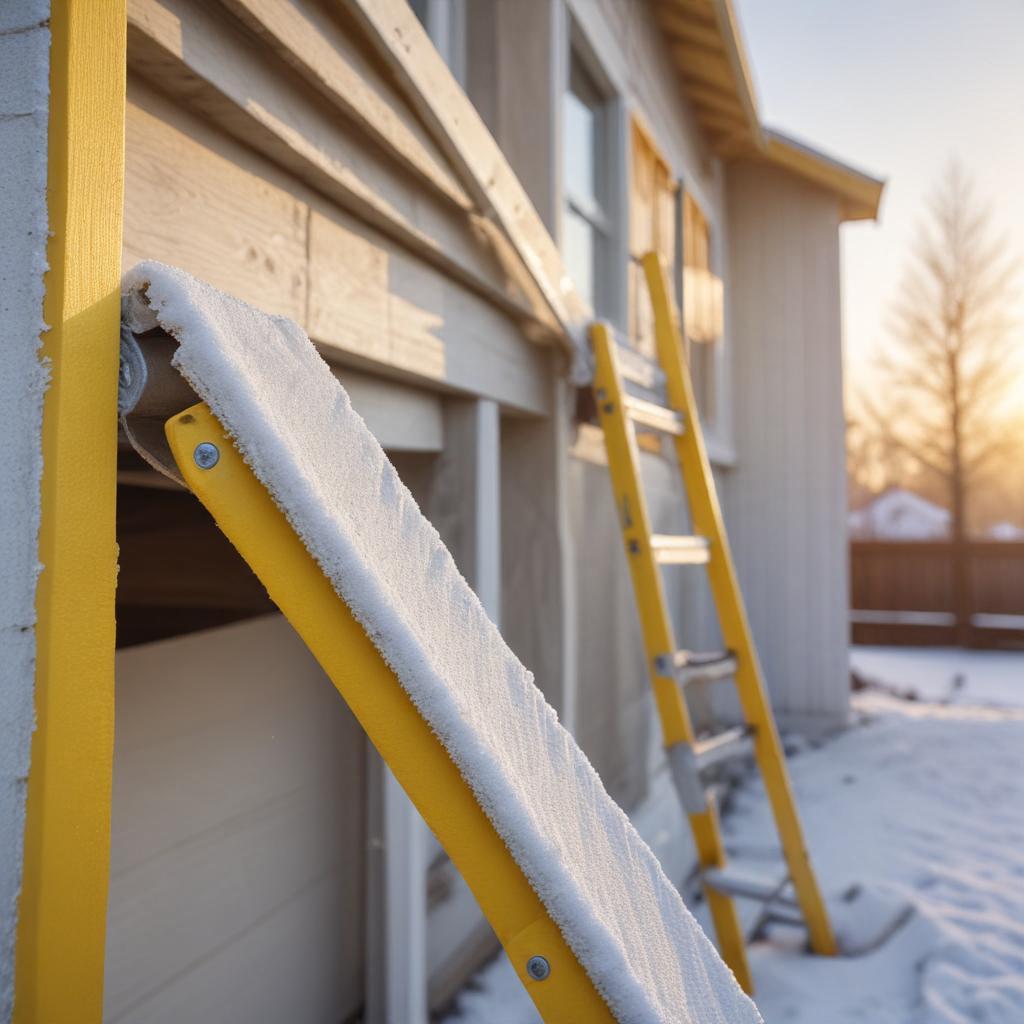
Frost on the Deck: Winter Fall Protection, Scaffold and Ladder Rules for Middle Tennessee Crews
Frost season has arrived in Middle Tennessee. On many late-fall and winter mornings, crews show up to roof decks, subfloors, scaffold planks and ladder rungs that are wet with dew or covered in a thin layer of frost. These surfaces may look dry from the truck, but they are often the slickest surfaces on the job. Winter work in the Midstate is mostly rain, frost and the occasional ice event, not deep snow. That means the risk usually comes from a surface that looks fine and isn't.
This post covers what the federal rules say about working at height and on slick surfaces, how they apply in Tennessee, and a practical morning routine for builders and remodelers working through the cold months.
Why falls deserve attention this winter
Falls are the leading cause of death in construction. According to the U.S. Bureau of Labor Statistics Census of Fatal Occupational Injuries, private-sector construction recorded 1,034 workplace deaths in 2024. Of those, 389 were caused by falls, slips and trips, and 95.9 percent of those were falls to a lower level. Construction made up almost half (48.8 percent) of all fatal falls, slips and trips in private industry that year. In residential building construction alone, BLS counted 138 fatal injuries in 2024, and 65 of them were falls, slips or trips.
Injuries that don't kill still cost a lot. BLS reports that in private construction, nonfatal falls, slips and trips that led to at least one day away from work happened at an annualized rate of 30.0 cases per 10,000 full-time workers in 2023–2024, compared with 22.6 across all private industry. For falls to a lower level, the gap is even larger: 13.9 per 10,000 in construction versus 4.1 for private industry overall.
Inspectors keep finding the same problems. OSHA's preliminary list of the most frequently cited standards for fiscal year 2026 again puts fall protection general requirements (29 CFR 1926.501) at number one. Scaffolding (1926.451) is fourth, ladders (1926.1053) are fifth, and fall protection training (1926.503) is eighth. Four of the top ten citations involve working at height.
Tennessee follows the federal construction rules
Tennessee runs its own state OSHA program, TOSHA, under the Tennessee Department of Labor and Workforce Development. TOSHA has adopted the federal construction standards in 29 CFR Part 1926, with limited exceptions listed in the state's rules. In practice, the fall protection, scaffold and ladder requirements below are the ones that apply on Middle Tennessee residential and light commercial jobs.
The 6-foot rule for residential work
Under 29 CFR 1926.501(b)(13), each employee doing residential construction work 6 feet or more above a lower level must be protected by a guardrail system, a safety net system or a personal fall arrest system, unless another part of the standard allows a different measure. If an employer can show that those systems are infeasible or create a greater hazard, the employer must develop and follow a written fall protection plan that meets 1926.502(k). The standard presumes the conventional systems are feasible, so the burden is on the employer to show they are not.
A few details from 1926.502 matter on a typical house:
- Guardrails. The top edge of the top rail must be 42 inches, plus or minus 3 inches, above the walking or working level.
- Fall arrest hardware. D-rings and snaphooks must have a minimum tensile strength of 5,000 pounds. Body belts have not been acceptable as part of a personal fall arrest system since January 1, 1998.
- Hole covers. Covers for holes in floors and roofs must support at least twice the weight of the workers, equipment and materials that could be on them at one time. They must be secured so wind, equipment or workers can't knock them out of place, and they must be color-coded or marked "HOLE" or "COVER."
That last point matters more in winter. Under 1926.501(b)(4), workers must be protected from falling through holes, including skylights, more than 6 feet above a lower level, by covers, guardrails or personal fall arrest. Stair openings, unfinished skylight framing and HVAC chases on a second floor are common examples. Wind can shift an unsecured sheet of plywood, and frost or a dusting of snow can hide where the opening is.
Scaffolds: no work on ice, and caution in high winds
The scaffold standard addresses winter conditions directly. Under 29 CFR 1926.451(f)(8), employees may not work on scaffolds covered with snow, ice or other slippery material, except as needed to remove that material. That covers frosted planks too. The first job on a frosty morning is clearing the platform, not starting the next course of siding or brick.
Wind is the other winter concern. Under 1926.451(f)(12), work on or from scaffolds is prohibited during storms or high winds unless a competent person has determined it is safe and the workers are protected by personal fall arrest systems or wind screens. Wind screens may only be used if the scaffold is secured against the wind forces they add. Fronts that come through the Midstate in winter often bring strong gusts, so check the forecast before planning a day of exterior scaffold work.
Ladders on wet, frosty or uneven ground
The ladder standard, 29 CFR 1926.1053, includes several rules that matter most when it's cold and wet:
- Ladders must be kept free of oil, grease and other slipping hazards (1926.1053(b)(2)). Mud, frost and ice on rungs count as slipping hazards in practice, so knock them off before you climb.
- Ladders may only be used on stable, level surfaces unless secured against accidental displacement (b)(6). Soft, saturated winter soil and frozen ruts are neither stable nor level.
- Ladders may not be used on slippery surfaces unless secured or fitted with slip-resistant feet (b)(7). The standard adds that slip-resistant feet are not a substitute for care in placing, lashing or holding a ladder on slippery surfaces such as flat metal or concrete.
- Non-self-supporting ladders should be set so the base is about one-quarter of the working length away from the top support (b)(5)(i), the familiar 4-to-1 rule.
- When a ladder is used to reach an upper landing, the side rails must extend at least 3 feet above that landing. If that isn't possible, the ladder must be secured at the top to a rigid support and a grab device must be provided (b)(1).
What OSHA says about winter roofs
OSHA's winter weather guidance notes that layers of ice can form as temperatures drop, making surfaces even more slippery. It also warns that snow-covered roofs can hide hazards such as skylights that workers can fall through. A surface weighed down by snow must be inspected by a competent person to confirm it is structurally safe before anyone goes on it. Where possible, OSHA recommends snow removal methods that keep workers off the roof. It also says employers should choose the right equipment, such as ladders or aerial lifts, and the right protective equipment, such as personal fall arrest systems and non-slip safety boots, and should train workers to use them.
For walking surfaces on the ground, OSHA's guidance is simple: clear snow and ice and spread deicer as quickly as possible after a winter storm, wear insulated, water-resistant boots with good rubber treads, and take short, slow steps on icy surfaces.
Training is a requirement, not a suggestion
Under 29 CFR 1926.503, employers must provide a training program for each employee who might be exposed to fall hazards. A competent person must deliver it, and it must teach workers to recognize fall hazards and follow procedures to reduce them. The employer must keep a written certification of the latest training. Retraining is required when the workplace or the fall protection equipment changes enough to make earlier training obsolete, or when a worker clearly doesn't have the understanding or skill needed.
Winter is a good time for a short refresher, especially for new hires, subcontractors joining mid-project, or crews switching from guardrails to harnesses as a house moves from framing to roofing.
A frosty-morning routine for Midstate crews
These steps cost little time and address the conditions behind most winter slips:
- Look before you climb. Check roof decks, subfloors, scaffold planks and ladder rungs for frost, dew or ice. If the surface is slick, wait for the sun to clear it or remove it before working.
- Clear scaffold platforms first. Remove frost, ice, mud and debris before anyone does other work on the platform.
- Re-check hole covers. Make sure covers over stair openings, skylights and chases are still in place, secured and marked "HOLE" or "COVER" after overnight wind or rain.
- Re-set ladders. Saturated or frozen ground shifts. Re-level and secure ladders each morning, keep the 4-to-1 angle, and keep 3 feet of rail above the landing or tie off the top.
- Inspect harnesses and lanyards. Cold, wet gear that was thrown in a truck bed overnight should be checked before use, and anchors should be checked after storms.
- Check the wind forecast. Plan exterior scaffold and roof work around gusty fronts, and have a competent person make the call when conditions are marginal.
- Mind the boots. Mud packed into tread makes a good boot slick. Clean soles before climbing, and keep a scraper or boot brush at the base of the ladder.
- Keep walkways clear. Spread grit or deicer on the paths between the truck, the material drop and the entrance, especially on shaded north sides that stay frozen longest.
Plan winter work with Music City Building Supply
Winter schedules in Middle Tennessee often come down to working around weather windows. Music City Building Supply is located at 504 Holtsford St, Lawrenceburg, TN 38464. Stop by or visit musiccitybuildingsupply.com to see what's currently available for your next build or remodel, and to plan material deliveries around the days your crew can safely work at height.
Sources referenced: U.S. Bureau of Labor Statistics, Census of Fatal Occupational Injuries 2024, Table A-1, and "National Safety Stand-Down highlights fall hazards in construction" (The Economics Daily, May 5, 2026); OSHA, Top 10 Most Frequently Cited Standards, preliminary FY2026; 29 CFR 1926.501, 1926.502, 1926.503, 1926.451 and 1926.1053 (eCFR); OSHA, Winter Weather Hazards/Precautions; Tennessee Department of Labor and Workforce Development, TOSHA Standards and Rules.Need materials for your next project?
We'll source it and get you a fast, no-obligation quote.